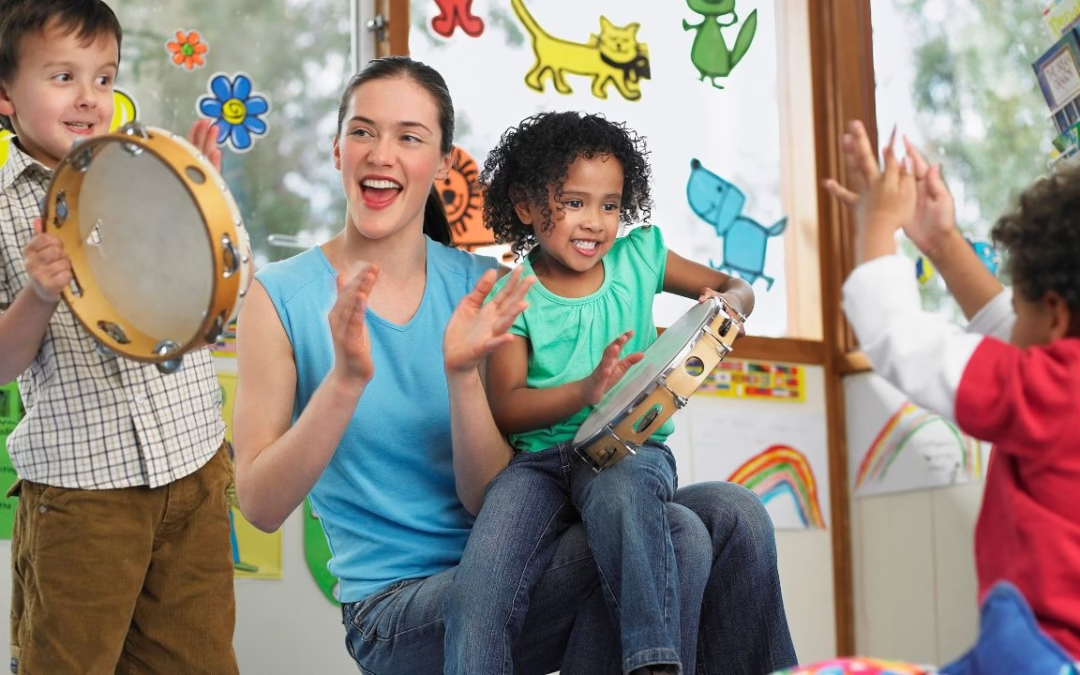
As a homeschooling mom teaching both my own children and other families—both in person and online—I’ve seen firsthand how powerful play can be in language learning. When children laugh, move, and create, they absorb words far more deeply than through worksheets or drills. For parents who want to introduce French at home but worry about not being fluent, I want to reassure you: you absolutely can teach French through play.
This article will give you practical, joy-filled ideas for teaching preschool and elementary-aged children French in ways that feel natural, simple, and connected to everyday life. I’ll also share some favorite resources, including Learn French and Go and my own children’s French books available on Amazon.
Why Play Works for Language Learning
Children are wired to learn through play. The rhythm of songs, the repetition in games, and the joy of movement all provide natural “hooks” for vocabulary to stick. Unlike memorization, playful learning taps into the senses: children see, hear, touch, and move—creating deeper memory connections.
As a French native and homeschool mom, I’ve taught both adults and children in New York City classrooms and now in our home and online community. The same truth keeps showing up: when French is fun, kids thrive.
1. Color Hop: Learning Colors Through Movement
- Cut out colored paper circles and spread them across the floor.
- Call out a color in French (e.g., “rouge!”) and have your child hop to it.
- Add variation: say, “saute sur bleu deux fois” (jump on blue twice) to sneak in numbers.
✨ Why it works: Kids associate movement with vocabulary. Colors and numbers become second nature when connected with action.
2. French Simon Says (Jacques a dit)
- Play Simon Says in French. Start with easy commands: “Jacques a dit, touche ta tête” (touch your head).
- Gradually add body parts, actions, and even props like toys.
✨ Why it works: Children learn verbs and body vocabulary while laughing and competing.
3. Songs & Music
French songs are powerful because rhythm and melody support memory. Start with classics:
- Frère Jacques (introduces daily routine words)
- Alouette (teaches body parts)
- Une souris verte (fun storytelling song)
Pair songs with hand motions or props. For example, flap arms like wings while singing Alouette.
✨ Resource tip: Check out Learn French and Go for curated playlists and child-friendly French music resources.
4. Role Play & Pretend Games
Children love acting out real-life scenarios. Set up a pretend café with toy food and play:
- Order food in French (“Je voudrais une pomme, s’il te plaît”).
- Practice greetings, “Bonjour, merci, au revoir.”
✨ Why it works: Kids see immediate use for French in daily life. It’s practical and memorable.
5. Art + French Words
Art is a natural space for vocabulary. While painting, say the colors in French. While drawing, introduce shapes: “un cercle, un carré, un triangle.”
✨ Extra idea: Label your child’s art project in French and proudly display it.
6. French Storytime
Choose bilingual or simple French storybooks. Read together, even if you aren’t fluent. Point at pictures as you say the words.
✨ My Resources: I’ve written two books designed exactly for this purpose:
- Young Missionaries Learn French Words While Traveling – A travel adventure that introduces French words in context.
- Young Missionaries Learn French Words In The Garden – A playful story that teaches nature and garden vocabulary.
These books are perfect for homeschool parents who want structured yet playful learning tools.
7. Scavenger Hunt in French
Hide objects around your home or yard and give clues in French:
- “Trouve un livre bleu” (find a blue book)
- “Apporte-moi une petite poupée” (bring me a small doll)
✨ Why it works: It combines listening skills, movement, and real-world vocabulary.
8. Cooking Together
Cooking in French makes mealtime a lesson:
- Count ingredients: “deux œufs” (two eggs)
- Use verbs: “mélange, coupe, verse” (mix, cut, pour)
✨ Why it works: Kids learn through sensory experience—touching, tasting, and smelling while hearing new words.
9. Nature Walk Vocabulary
Take a walk and point out things in French:
- “un arbre, une fleur, un chien”
- Bring along flashcards or make your own drawings to match.
✨ Extension: After the walk, review by drawing or labeling what you saw.
10. Bible Verse of the Week in French
Choose a simple verse (e.g., John 3:16) and learn it in French together.
- Break it into short phrases
- Use hand motions or draw illustrations for key words
✨ Why it works: It connects faith and language, giving your child both spiritual and educational growth.
Gentle Advice for Parents Who Aren’t Fluent
Many homeschooling moms hesitate to teach French because they don’t feel confident in their own skills. Here’s what I tell every parent I work with: you don’t need to be fluent to introduce French. Your willingness to learn alongside your child models humility, curiosity, and persistence.
Start small. One word, one song, one game. Over time, those seeds will grow into a love for language and a vision for connecting with others.
Final Encouragement
French learning at home doesn’t need to feel like “schoolwork.” With play, songs, art, and everyday life, your child can build a foundation of joy and vocabulary that will last a lifetime. Whether you’re teaching with flashcards, a game in the living room, or reading a book together, remember: your presence and joy make the biggest difference.
For parents ready to take the next step, explore Learn French and Go for additional resources, and check out my Young Missionaries Learn French Words books on Amazon for story-based learning.
Bon courage, maman—you’ve got this!